Terry is a powerhouse of unending energy, creativity and expertise within the greenroofing industry. We’ve known him for almost 10 years when he wrote me about the similarity of the names between my then column “Sky Gardens ~ Travels in Landscape Architecture” here on Greenroofs.com (which ran from 2003-2006) and his company Gardens in the Sky – a greenroof design/build, contractor, and installation expert. He’s a great guy with a deadpan sense of humor whom we respect and enjoy:
Terry McGlade is one of Canada’s best known greenroof experts. Terry is a creative, dynamic forward thinking horticulturalist and landscape designer with 30 years of experience and has been designing and building gardens in the Toronto area since 1982. He created his first roof garden in 1985, and installed his first green roof in 1999. Terry is the founder and President of Gardens in the Sky which has built over 50 greenroofs and numerous roof gardens and received many awards. Now part of Flynn Canada Ltd., Gardens in the Sky has the advantage of being part of Canada’s leading building envelope trade contractor. They deliver outstanding green roofs & roof gardens for commercial, institutional, & industrial projects. Terry has been involved in the design and execution of some of Canada’s largest and most complex green roofing projects in the commercial, institutional and residential market areas.
In “Constructing Gardens in the Sky” Terry says that each greenroof has its own design. Sites that appear similar are not, given wind patterns, sun patterns, slope and drainage issues.
This presentation delves into case studies of three different greenroofs both from an installation perspective and a lessons learned perspective. Biodiversity of each roof is discussed along with growth habits of the installed greenroofs. Assumptions in the original design concepts are re-evaluated vis-à-vis the existent greenroof.
Enjoy! Visit greenroofs.tv to see “Constructing Gardens in the Sky” or click below:
As I told you about last week when I introduced the “Greenroofs & Walls for Educational & Social Equity in the Bronx” video from our inaugural Greenroofs & Walls of the World™ Virtual Summit featuring New York State Senator Gustavo Rivera, Bronx Borough President Ruben Diaz Jr., Robert Bieder, Jon Beuttler, Jess Dannhauser, Javier Lopez and Steve Ritz, Steve has the honor of speaking tomorrow at TEDxManhattan “Changing the Way We Eat” at the Times Center in New York City.
I’m sure you’re all aware of the awesome speakers highlighted at the inspirational organization, TED!
“TED is a nonprofit organization devoted to Ideas Worth Spreading. Started as a four-day conference in California 25 years ago, TED has grown to support those world-changing ideas with multiple initiatives. The annual TED Conference invites the world’s leading thinkers and doers to speak for 18 minutes. Their talks are then made available, free, at TED.com. TED speakers have included Bill Gates, Al Gore, Jane Goodall, Elizabeth Gilbert, Sir Richard Branson, Nandan Nilekani, Philippe Starck, Ngozi Okonjo-Iweala, Isabel Allende and UK Prime Minister Gordon Brown.” ~ TED
TEDx is an independently organized event and licensed by TED. The TED Conference provides general guidance for the TEDx program, but individual TEDx events are self-organized:
“In the spirit of ideas worth spreading, TEDx is a program of local, self-organized events that bring people together to share a TED-like experience. At a TEDx event, TEDTalks video and live speakers combine to spark deep discussion and connection in a small group. These local, self-organized events are branded TEDx, where x=independently organized TED event.” ~ TEDx
In February of 2011, over 14,000 computers tuned in from locations all over the globe to watch the live simulcast of the first TEDxManhattan “Changing the Way We Eat.” Tomorrow, Saturday, January 21, 2012, the second TEDxManhattan “Changing the Way We Eat” will explore the issues, the impacts and the innovations happening as we shift to a more sustainable way of eating and farming and help to create connections and unite different areas of the food movement.
The cool thing about this is that although it is a live, local event held in Manhattan, anyone with access to a computer can watch the webcast live at www.livestream.com/tedx from 10:30am – 5:15pm EST tomorrow, Saturday January 21st.
There’s a world-class line-up of speakers that is sure to inspire you (for a complete list, see here), including:
•Laurie David (Host), Environmental Activist, Producer, Author
•Fred Kirschenmann, Farmer, Distinguished Fellow at the Leopold Center for Sustainable Agriculture at Iowa State University, and President of the Stone Barns Center for Food and Agriculture in NY
•Mitchell Davis, Executive Vice President, the James Beard Foundation, cookbook author and food journalist
•Wenonah Hauter, Executive Director of Food & Water Watch
•Gary Oppenheimer, Founder/Executive Director of AmpleHarvest.org, CNN Hero, Master Gardener, Huffington Post 2011 Game Changer, winner of the 2011 Glynwood Wave of the Future Harvest Award
•Dr. Robert S. Lawrence, Center for a Livable Future/Johns Hopkins Bloomberg School of Public Health
•Wayne Pacelle, President and CEO of The Humane Society of the United States
•Dr. David Wallinga, Institute for Agriculture and Trade Policy
•Urvashi Rangan, Consumer Reports
•and our extremely hardworking and passionate friend, Stephen Ritz, Educator/Administrator in the South Bronx.
Bronx teacher and administrator Stephen Ritz will be presenting the 245 slide BRONX based presentation entitled: ”Green Bronx Machine: Growing Our Way Into A New Economy will focus on NYC DOE school children and THE GLORY AND BOUNTY OF BRONX COUNTY!!!”
This award winning program was recently cited in the December 2011 Issue of Principal Leadership: National Association of Secondary School Principals as one of five national exemplars of service learning, and continues to move the most disenfranchised and marginalized students from the poorest Congressional District in America into living wage career opportunities while harvesting minds and cultivating hope across the Bronx and NYC.
This sounds like a great opportunity for people around the world to connect online with each other (sounds like the mission of our Greenroofs & Walls of the World™ Virtual Summit!) about the sustainable food movement, which we know of course includes the amazing applications for growing food on rooftops and walls! While the talks revolve around the speakers in NYC, I’m sure we’ll all take away a great deal of information that we can apply to our own communities.
Aramis and I have known Nigel for a while now, probably about nine years or so – he is quite a gentle yet very enthusiastic and passionate soul when it comes to greenroofs and living walls! We run into him all over the place at conferences worldwide: Nuertingen, Boston, Basel, London, Singapore… and with his years of study and knowledge, we were so happy he agreed to participate in our Virtual Summit!
Research on greenroofs has been under way by the Department of Landscape at the University of Sheffield investigating the range of plant material that is suitable for use on extensive and semi-extensive greenroofs in the UK climate since 2003. Further trials investigate plant establishment methods, particularly the use of seed mixtures to establish meadow-like communities of both native and non-native grasses and flowering plants:
Nigel Dunnett, PhD is Director of the Green Roof Centre and Professor in Planting Design and Urban Horticulture at the University of Sheffield, UK. With a background and experience in botany, ecology, horticulture and design, his teaching and research focuses on sustainable urban planting approaches to maximise benefit to people and wildlife. He is lead author of Planting Green Roofs and Living Walls, 2nd edn 2008; Small Green Roofs: Low-Tech Options for Greener Living, 2011; and Rain Gardens, 2007. He convened the First and Second National Green Roof Conferences in the UK, and acts widely as a consultant on urban planting design matters. He devised the vegetation strategy for the green roof on the Sharrow School, UK – the world’s first purpose-designed and government-designated green roof nature preserve, and is currently horticultural consultant to the London 2012 Olympic Park.
Dr. Nigel Dunnett’s “Sky Meadows – Integrating People and Nature: Sustainable Green Roofs and Roof Gardens” presentation proposes that green roofs represent a unique opportunity for inserting large areas of diverse, naturalistic, biodiversity-supporting, and beautiful vegetation into the heart of our urban areas: an opportunity that is virtually impossible to repeat in the same way on the ground.
Sustainable solutions now exist for all contexts: large and small, public, private, intensive through to extensive. Drawing upon the dramatic potential of dryland vegetation around the world, and his own research and practice, the author looks again at the ethical and aesthetic considerations for creating green roofs that are exciting for people, beneficial for wildlife, and low in resource-use.
Enjoy! Visit greenroofs.tv to see “Sky Meadows – Integrating People and Nature: Sustainable Green Roofs and Roof Gardens” or click below:
Greenroofs.com Project of the Week: 1/09/12 Heritage Flight South Burlington, VT, USA 15,000 sf. Greenroof
Year:2009 Owner: Heritage Aviation, Inc. Location: South Burlington, VT, USA Building Type: Aviation Type: Extensive System: Single Source Provider Size: 15,000 sq. ft. Slope: 1% Access: Accessible, By Appointment
Project Description & Details
Heritage Aviation is an environmentally green LEED Gold aviation campus FBO in the Green Mountains of Vermont. This highly sustainable expansion project re-uses an existing empty hangar as the core for a new building. Careful consideration was given to reduce the impact of this project on the site and the surrounding community infrastructure.
Designed by landscape architect and greenroof designer, Jeff Hodgson, partner with H. Keith Wagner Partnership, the Heritage Flight LiveRoof® Standard System greenroof has multiple plant mixes in the design. Architects TruexCullins incorporated many ecologically responsible design elements including a parking lot made with pervious pavement and a 35,000-gallon tank that collects rainwater from the roof which is used for washing airplanes and site irrigation. Heritage Aviation is the first GA facility in the U.S. to have an FAA-approved community-scale wind turbine on site; it supplements solar panels.
Heritage Aviation, Inc. is the corporate entity that houses the three specialized business divisions at Burlington International Airport (BTV): Heritage Flight, Heritage Maintenance Services, and the new 24/7 FBO (fixed base operator). Designed by hometown architects TruexCullins, the company says their new FBO is the perfect complement to their award-winning maintenance, avionics and charter divisions.
Along with TruexCullins Architecture and Interior Design, on June 30, 2011, Heritage Aviation received the 2011 Vermont Govenor’s Environmental Excellence in Resource Conservation Award. It was also honored with the Efficiency Vermont’s 2010 Best of the Best Award in Commercial Building Design & Construction and the Burlington Business Association’s Hertzel N. Pasackow Architectural Excellence Award.
Heritage Aviation opened its environmentally green FBO at Burlington International Airport in the Green Mountains of Vermont on May 20, 2010.
“Heritage Aviation is committed to protecting the environment, the health and safety of our employees, and the community in which we conduct our business. It is our policy to seek improvements throughout our business operations to lessen our impact on the local and global environment by conserving energy, water, and other natural resources; reducing waste generation; recycling and purchasing recycled products; and reducing our use of toxic materials. We are committed to pollution prevention, continual improvement and meeting or exceeding all environmental regulatory requirements.” ~ Heritage Aviation
In fact, Heritage Aviation’s policy is to “give preference to suppliers whose products have environmental friendly attributes that reduce natural resource consumption and greenhouse gas emissions in the product life cycle, maximize post consumer recycled content, minimize toxicity and packaging, or have any other environmentally preferable attributes, with comparable quality and price.”
They point out that even their building is recycled – originally constructed in 1954 as an Army National Guard hangar, the building was stripped to its steel and concrete skeleton and reborn as the present 80,000-square foot state-of-the-art facility.
The new facility offers comprehensive amenities including a roof-top observation deck, flight-planning room, conference room, lounge, gym, game room, movie theater, quiet rooms for the pilots, aircraft owners, and passengers to rest, heated hangar space, and U.S. Customs on site – tour the facilities here.
According to the website, some of the key energy-efficiency measures and environmental design aspects of the new FBO include:
- “One of the largest green roofs in New England. Rainwater that falls on the rooftop vegetation is then collected and re-used for aircraft cleaning and irrigation. The roof also keeps the building warmer in the winter and cooler in the summer.
- On-site renewable energy production, including solar panels and a 100-kW FAA-approved wind turbine, the first ever installed at an airport.
- A fleet of zero-emission electric ground vehicles, including four aircraft tug vehicles and an electric cherry picker.
- A parking lot constructed from pervious pavement, a porous substitute for traditional asphalt, that allows water to be absorbed into the ground rather than pouring into storm drains.
- Extensive use of skylights and daylighting in the hangar, plus all-white paint that allows natural light to reflect as much as possible, saving about 200 kilowatt hours for every day the facility is in use. It also makes for a more pleasant work environment for our crew.
- A lighting system that monitors the available natural light and responds accordingly to provide the optimum balance of natural and artificial light throughout the building.
- Solar-powered hot water.
- Locally sourced and eco-friendly construction materials.”
The large modular LiveRoof® greenroof was the crowning jewel of the stormwater management strategy. Yet there are also stormwater detention basins at Heritage Aviation, below, and the huge 87,117 sf pervious parking lot.
Landscape architect Jeff Hodgson, of H. Keith Wagner Partnership, says the remnants of the existing asphalt parking lot were removed and recycled, and replaced with a 47,486 square foot permeable concrete parking lot that filters rainwater, helps recharge the ground water,and reduces the amount of water entering the storm water system significantly. Add that to the 35,000-gallon rainwater harvesting tank below it, and you’ve designed a great system!
“The vegetated roof retains the first 1″ of rainfall that falls on it, with the excess directed toward underground irrigation tanks. When installed, this was the largest green roof in New England, and it remains today the largest in Vermont.” ~ TruexCullins Blog
Aside from the living roof, another very cool item is the community-scale wind turbine with a blade diameter of 21 meters. After working closely with the FAA to ensure it posed no risk of interfering with aircraft guidance signals, they were able to include it – the first at a U.S. airport.
The upper roof of the main hangar is also eco-friendly, covered with a highly reflective white membrane that reduces solar heat gain. In conjunction with the 10-panel 65.2 MBtu solar thermal domestic hot water system and adjacent 120-panel 25.2 kW solar photovoltaic array, Heritage Aviation expects its annual energy consumption from the grid to be in the region of 600,000 kilowatt-hours instead of the one million kWh it would have consumed without the wind and solar power-generating equipment.
The property is open to visiting with prior arrangements. For example, last fall 2011, students from Middlebury College in Middlebury, Vermont included a visit here in one of their Environmental Studies seminars, above and below:
TruexCullins wrote an nice 5-part series on the project at their blog entitled “Heritage Flight Week” – start at Day 1.
“For 55 years, the National Guard used this hangar for aircraft maintenance. Now that we’ve completely renovated it to green building standards, we’ll continue to use it for maintenance and FBO activities in support of the GA community.” ~ Christoper A. Hill, President of Heritage Aviation
Watch the very informative Heritage Aviation’s ’smarter, greener building’ video (3:42) narrated by Christoper A. Hill on YouTube below:
Kudos to Heritage Aviation and designers for promoting a sustainable model for the aviation industry. By the way, the bold geometric waves of the sedum greenroof are best seen from above, which is not hard to do when you’re located at an airport!
Today we have the pleasure to air our first of seven panel sessions from our Greenroofs & Walls of the World™ Virtual Summit on greenroofs.tv and our GreenroofsTV channel on YouTube: ”Greenroofs & Walls for Educational & Social Equity in the Bronx” featuring New York State Senator Gustavo Rivera, Bronx Borough President Ruben Diaz Jr., Robert Bieder, Jon Beuttler, Jess Dannhauser, Javier Lopez and Steve Ritz.
We feel extremely honored to have had seven luminaries join us from New York City who are all passionate about where they all work, The Bronx. This is a very important roundtable discussion to hear for those people interested in learning about the passion and commitment of the civic, education, and business leaders of The Bronx and her constituents – and it’s also a great venue to see their real life challenges and triumphs of promoting and implementing greening policies as well:
Fueled by a passionate and committed Bronx Borough President, Ruben Diaz Jr., it is common knowledge that the Bronx is leading NYC in embracing green technologies and the green economy. To wit, the policies and educational initiatives underway in and of the Bronx are making dramatic strides in the quality of life and opportunities for all residents with concentric benefits and ripples felt citywide, statewide and nationally.
This panel featuring: a State Senator, noted business leader, NYC project manager, health care manager, social service providers and a dedicated educator speaks to triple bottom line benefits, impacts and the uses of green roofs, green walls, and urban agriculture as highly replicable, critical components to creating and leveraging social equity and economic and educational opportunities in challenging times.
Bronx, NY, USA. Robert Bieder is a third generation Bronx businessman who, with his family, owns and operates Westchester Square Plumbing Supply where this past December they had installed solar panels and reduced their electric costs by 60%. In addition, they are a leading distributor of water and fuel saving devices. Bob is also a member of the Bronx Coalition for Parks & Greenspaces, Chairman of the Bronx Merchants Coalition, and a member of Bronx Community Board 10.
New York, NY, USA. Jonathan Beuttler is a Project Manager in the Division of New Construction of the New York City Department of Housing Preservation and Development (HPD), the largest municipal developer of affordable housing in the nation. Prior to joining HPD, Jonathan wrote successful grant proposals for urban farming start-ups and policy proposals supporting growth in the urban farming industry. Jonathan has worked at the Department of Citywide Administrative Services, the Fashion Center Business Improvement District and is a return Peace Corps volunteer.
Jess Dannhauser
New York, NY, USA. Jess Dannhauser is Graham Windham’s Senior Vice President for Program Performance and Planning. Jess came to Graham Windham from the Administration for Children’s Services (ACS) where he had been serving as the Associate Commissioner for Performance Measurement, Monitoring and Improvement. As Associate Commissioner, he was in charge of ACS’s performance measurement and consultation system which aims to drive performance improvements in all of New York City’s non-profit child welfare agencies. He has extensive experience in New York City agencies as the former Chief of Staff for Commissioner John Mattingly and the Special Assistant to now Deputy Mayor Linda Gibbs when she was Commissioner at the Department of Homeless Services. Jess received his Master’s of Social Work from the University of California, Berkeley and his BA in Psychology from Duke University.
Ruben Diaz, Jr.
Bronx, NY, USA. Elected Bronx Borough President in the Special Election on April 21st, 2009, Ruben Diaz Jr., previously served in the New York State Assembly since 1997, representing the 85th Assembly District. He demonstrated passion for constituent service, social advocacy and community empowerment balanced with support for sensible, green economic development and job creation programs. He sponsored and secured passage of important and innovative laws to address the consequences of the intolerable levels of asthma in the South Bronx, healthcare insurance fraud, and quality of life concerns. Throughout his seven terms in the State Legislature, Ruben Diaz Jr. was a champion for working families in the Bronx. A staunch defender of the environment, he is a leading voice against environmental racism and injustice. He graduated from Lehman College, City University of New York, with a Bachelors degree in political theory.
Bronx Borough President Ruben Diaz Jr. was interviewed after the panel session for Greenroofs.com at the Bronx County Courthouse.
Javier Lopez
New York, NY, USA. Javier Lopez is the Director of the New York City Strategic Alliance for Health (SAfH). SAfH is a consortium of advocates, community activists, organizations and professionals with an interest in lessening the impact of obesity, diabetes and cardiovascular disease in Northern Manhattan, North and Central Brooklyn, and the South Bronx. The goal of the consortium is to develop local obesity prevention policy, system, environmental changes that can be adopted citywide. Javier has a BA from the State University of New York at Albany and a Master’s of Public Administration from Baruch College where he was also named a member of the National Urban Fellow program. In 2007 he was named a member of Cornell University’s “Strength through Diversity” Young Professionals Leadership Program.
Gustavo Rivera
Bronx, NY, USA.New York State Senator Gustavo Rivera was born in Santurce, Puerto Rico and graduated from the University of Puerto Rico. In 1998, Rivera came to New York to begin a doctoral program in political science at the Graduate Center of the City University of New York. He has lived in the Bronx for ten years. Gustavo Rivera was elected State Senator for New York Senate District 33 in November of 2010. The 33rd Senate District consists of the Northwest Bronx including Kingsbridge Heights, East Tremont, Crotona Park, Fordham, Bedford Park and parts of Riverdale. As a State Senator, Gustavo Rivera has been working to change the way business is done in the legislature and to ensure that the families of the 33rd Senate District have a voice in Albany. In addition to serving as a State Senator, Gustavo Rivera continues to serve as an adjunct professor at Pace University, where he teaches courses in political science. For the last ten years, Rivera has also served as a faculty member and mentor for “Somos el Futuro,” the annual Model State Senate program sponsored by CUNY, SUNY, the NY State Assembly, and the Puerto Rican Hispanic Task.
Steve Ritz
Bronx, NY, USA. Stephen Ritz is an acclaimed NYC DOE educator/administrator whose work in the Bronx continues to attract national attention and support. To date, he has grown more than 20,000 pounds of Bronx vegetables with his extended Bronx Family – the youngest certified workforce in America – who operate a profitable, in school, student Farmers Market and routinely install green walls and green roofs across NYC/NYS. Steve continually champions living wage opportunities along with stellar academic results for his students and his work has been recognized and celebrated by CNN, NBC, ABC, NY Academy of Medicine, US EPA, USS Intrepid, United Nations amongst others. Learn more about him and support his newest vision on Facebook and YouTube.
The “Greenroofs & Walls for Educational & Social Equity in the Bronx” video was filmed at the Bronx office of State Senator Gustavo Rivera in September, 2011. Enjoy! Visit greenroofs.tv to see “Greenroofs & Walls for Educational & Social Equity in the Bronx” or click below:
Next week on January 21st, 2012, Bronx educator Steve Ritz will be presenting at the sold-out TEDxManhattan on this very subject. See him at right, standing next to one of the GLT Mobile Edible Wall Units – full of fresh herbs and veggies -which he uses in his classrooms. (See Caroline Menetre’s related “GLT in NYC: A Weekend of Training, Education, & Fun“ Sky Gardens Blog post of January 21, 2011.)
Greenroofs.com Project of the Week: 1/2/12 Delft University of Technology Library Delft, The Netherlands 16,146 sf. Greenroof
Year:2009 Owner: ING Vastgoed Location: Delft, The Netherlands Building Type: Educational Type: Intensive System: Single Source Provider Size: 16,146 sq. ft. Slope: 15% Access: Accessible, Open to Public
Project Description & Details
Constructed in 1960s, Delft University originally built their intensive greenroof in 1997. Meant for recreation over the library, in 2009 the greenroof was renovated. The 15,000 m² library contains extensive underground book archives, reading rooms, the university publisher, offices, Trésor for historical books and exhibitions, study spaces, and a book binder and book shop. It won the National Steel Award 1998 and Corus Construction Award 2000. Enjoyed throughout the year, the greenroof is converted into a sledding hill in the winter.
Mecanoo Architecten designed the library as a sloped plane, extending the grass from the ground to the very edge of the roof: “With a grass-covered roof, high-performance glazed facades and subterranean storage for heating and cooling, the building reaches high standards of sustainability.” With the 2009 roof renovation, the existing leaking single ply roofing was removed and replaced by a fully adhered two layered roofing system on a cellular glass insulation. ZinCo Elastodrain gives protection for the roofing system; the lightweight 6 inch deep substrate and lawn complete the ZinCo green roof build-up.
Contractors:Leven op Daken, Mastum Daksystemen, Van der Tol
Additional Info
Founded in 1842, Delft University of Technology is the oldest, largest, and most comprehensive technical university in the Netherlands. With eight faculties and numerous research institutes, the “Technische Universiteit Delft” in Dutch or TU Delft for short, covers four focus areas: energy, mobility & infrastructures, health and environment.
Constructed in 1997, Delft-based Mecanoo Architects designed the striking and airy Delft University of Technology Library as a contrast (yet complement) to the Aula or General Assembly Hall, built in 1966 by architects Van Den Broek & Bakema, softening this imposing Brutalist structure that sits across the way.
The photo below by Francine Houben is taken from the perspective of the library greenroof flowing down towards the hulky Aula, demonstrating its relationship with the adjacent landscape:
The central library appears to rise out of the earth, covered with soft grass for all sorts of recreation and pierced by its iconic steel cone.
The cone is more than an architectural statement – it’s topped by a massive skylight that not only provides lighting to the interior but it also helps highlight the cone from the interior. The building consists of five levels, four of which are contained in the conical volume.
A suspended gallery of books against cobalt blue walls runs right through all four levels.
And floor to ceiling glass panes allow daylighting to stream in throughout the multi-level space:
Who better than the architects than to describe the project? Read on from Mecanoo:
“symbiosis
In designing a large new university library, various references come to the fore. Famous libraries, ranging from the old Bibliothèque Nationale in Paris (1875) by Henri Labrouste to the Stockholm Municipal Library (1927) by Erik Gunnar Asplund, have called for an advanced contemporary building. Today such a building must be a gateway to the digital highway but must also refer to important traditions, including access to knowledge and the rarefied atmosphere of study within a splendid environment. In the case of Delft, with a thousand workstations and facilities to accommodate three thousand students each day, the building must also be the heart of the university and provide a landmark within a campus the size of a small town. The design must also consider its relationship with the centrally placed auditorium, the brutalist building by Van den Broek and Bakema, great names in the history of the university and Dutch architecture. Through contrast, a symbiosis has been established – the towering concrete of the auditorium and the landscape in which the library is sited form a new unity.
pushpin
The large lawn roof is tilted up at one corner like a sheet of paper held by a single point. The hollow beneath houses the library. A cone, the symbol of technology, pierces the library and the landscape, affixing them like a pushpin. With a grass-covered roof, high-performance glazed facades and subterranean storage for heating and cooling, the building reaches high standards of sustainability. The entrance affords a glimpse of the sunken book stacks for rare and irreplaceable books. Inside the towering suspended bookcase for the less fragile books astonishes the visitor. The deep blue background gives the wall-to-wall racks the feel of a theatre set. The columns in the central hall are not only structural but also provide lighting and heating. The sloping metal ceiling continues without interruption across all spaces above a floor the colour of Saharan sand.
perspective
A library must provide an environment that enables concentration through silence, comfortable furniture and pleasant lighting. Daylight penetrates the building not only through the climate-control glazing in the facade but also through the cone that pierces to the heart of the building. The cone also gives form to a variety of study rooms. The space that adjoins the central hall contains long tables with three hundred workstations with partitions in a shifting perspective indebted to Labrouste.” ~ Mecanoo TU Delft profile
The TU Delft Library provides guided tours for groups of users and associates of the library in either Dutch or English which are arranged by appointment; to apply, contact customer service at Ask Your Library. Their website says that groups of architects, and I would imagine other design professionals, can be given a guided tour by the architectural firm Mecanoo, focusing on the construction and design of this light, spacious, and unique building.
Now that the Delft University of Technology Library greenroof has been completely renovated with a ZinCo system, it can be enjoyed for decades to come. Here’s a truly ecologically designed library that can be used throughout the seasons, both inside and out. How many libraries can claim that?
See some outstanding (copyrighted) photos from Flickriver here and architectural drawings by Mecanoo on Ziba here.
Through their awards program, the AIA has a long tradition of recognizing individuals and organizations for their outstanding achievements in support of the profession of architecture and the professional organization.
“The Institute Honor Awards program recognizes achievements for a broad range of architectural activity to elevate the general quality of architecture practice, establish a standard of excellence against which all architects can measure performance, and inform the public of the breadth and value of architecture practice.” ~ AIA
We’re big fans of BIG Architects – sorry, couldn’t help it – which is very easy since every project they produce is not only fresh and out-of-the box but a shining example of ecological, site-specific and community-specific design.
“The 8 House masterfully recreates the horizontal social connectivity and interaction of the streets of a village neighborhood through a series of delightful accessible ramps in a mixed use, multifamily housing project. The skillful shaping of the mass of the facility provides an invigorating sculptural form while creating the ramped “pedestrian” street system and providing full depth dwelling units which are filled with light and views.
People really ‘live” in this newly created neighborhood with shopping, restaurants, an art gallery, office facilities, childcare, educational facilities and the sound of children playing. This is a complex and exemplary project of a new typology.” ~ 2012 Institute Honor Awards for Architecture Jury Comments
See all of the other eight 2012 AIA Awards Recipients here.
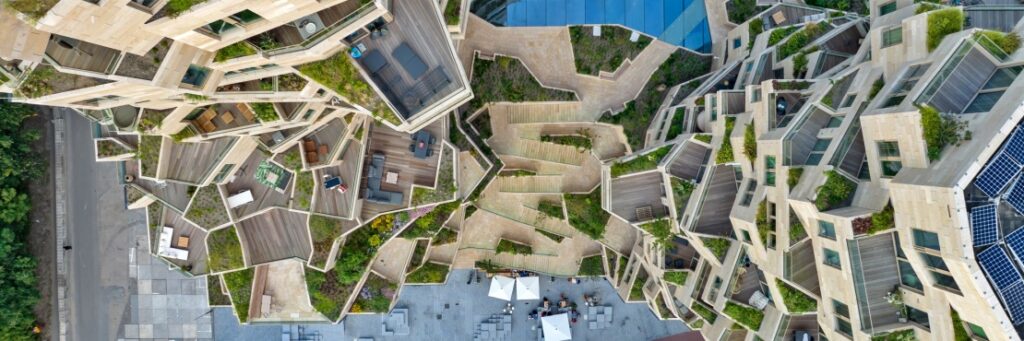
You’ll find three different types of residential housing and 110,000 ft² of retail and offices here, in the shape of a multi-level bow tie. And this mixed-use building comprises Denmark’s largest private development ever undertaken.
Plus, a building designed to allow its residents to bike all the way from the street up to its 10th level penthouses is pretty cool, but add a huge V-shaped sloping greenroof to it, and you’ve really got a spectacular structure!
“Having established ourselves in New York City this past year we are honored that the AIA has given this great distinction to the 8 House which is a further realized example of our approach called architectural alchemy – the idea that by mixing traditional ingredients, retail, row-houses and apartments in untraditional ways – you create added value if not gold. Housing projects are rarely brought out as world architecture. The fact that the 8 House has now achieved this honorable status, can be seen as a symbol of a piece of architectural alchemy that works. Moreover, I am genuinely happy that our long and inspiring cooperation with Per Høpfner and St. Frederikslund is rewarded in the other parts of the world.” ~ Bjarke Ingels, Founder & Partner, BIG in the January 9, 2012 Press Release
I wrote about 8 House or 8 Tallet last September, 2011 when we featured it as our Greenroof of the Week, or GPW – read all about it here where you can see all the stunning photography of the site and interiors, and see the profile in The Greenroof & Greenwall Projects Database.
Inspirational 8 House is “architectural alchemy” indeed! Congratulations to BIG and everyone else who worked on this beautiful and highly functional project!
Greenroofs.com Project of the Week: 12/19 & 26/11 Tremco Incorporated Headquarters Beachwood, OH, USA 9,000 sf. Greenroof
Year:2010 Owner: Tremco, Inc. Location: Beachwood, OH, USA Building Type: Corporate Type: Semi-Intensive System: Single Source Provider Size: 9,000 sq. ft. Slope: 1% Access: Accessible, Private
Project Description & Details
Tremco Incorporated is dedicated to the development of high-performance buildings characterized by energy efficiency, limited environmental impact and low operating costs. Last year (in 2010) they began a foundation-to-roof renovation of its 40-year-old-headquarters with the goal to transform the building into a showcase of sustainability that would achieve LEED Gold certification.
Tremco’s new 46,000 sf corporate headquarters incorporated numerous sustainable features into its renovation including four types of sustainable roofing systems. The vegetated roof features 46 species with almost 16,000 plants, designed with four different sections to create a variety of low-maintenance plant life and edibles; the new HQ also has a living façade trellis system on several walls on top of the roof. During the renovation, Tremco sent nothing to landfills. Almost 100 percent of everything removed was recycled, reused or burned for energy.
Greenroof Designer: Evan Tozier, Rana Creek Restoration Habitat Green Façade System: FRP planters and VertiGreen trellis, Tournesol Siteworks
Additional Info
Completely renovated from top to bottom at a cost of $5.5 million, the 40-year old Tremco Incorporated (an RPM Company) headquarters is now a sustainable, high performance building that is energy efficient, has limited environmental impact and operates with the lowest possible life-cycle costs.
Made possible by their parent RPM Building Solutions Group companies and other partners, the objectives were to improve energy efficiency and conserve water; reduce operational costs; provide a safer, healthier facility; and protect the natural environment by reducing our carbon output, lowering the local heat island effect, and recycling and reusing material to keep it from being hauled to a landfill. Their goal is to become one of the few LEED Gold certified facilities currently located in Ohio.
The wealth of internal expertise of the sister companies was obvious and the project was viewed as a showpiece of their innovative people, services, and products as well as of sustainable construction technology.
“It leverages what we do best: help building owners maintain what they have. That was the driving force behind the company’s coatings business. Since our company was founded, our goal has been to help owners extend the life of their roofs and, ultimately, their entire building. That’s the best form of sustainability, and it minimizes what goes to landfills. We wanted to demonstrate what we could do in a bigger and better way — and what better way to walk the talk than with our own headquarters.” ~ Deryl Kratzer, President of the Tremco Roofing and Building Maintenance Division in Roofing Contractor, October 2011
Construction best practices that WTI, the general contractor on the project, and its subcontractors followed to increase the project’s sustainability included:
Onsite sorting of materials
Recycling of all non-hazardous material
Chain-of-custody documentation for all off-site recycling
Reusing materials as applicable
Verifying that materials are certified for LEED credit
You can follow their blog, “Building Green on Green – The Tremco Headquarters Green Transformation” which chronicled the renovation of Tremco Incorporated’s headquarters and continues to report on sustainability concerns for the company. For example, in October, 2010 Tremco HQ launched a commitment to being a zero landfill facility and as of the end of October, 2011, it had kept more than 190,000 pounds out of the landfill since November 2010.
According to the website, the Tremco HQ renovation’s most noteworthy sustainable features include:
- Four types of sustainable roofing systems:
* Vegetated roof featuring local plants. Low impact lighting and a water capture system are integrated with the roof with a pathway of recycled materials. Signs describe the roof’s features and provide information about the plant palette.
* The ENERGY STAR® qualified Rock-It™ roof surfacing system, composed of white gravel set in white adhesive.
* A white, reflective, single ply system installed beneath a rooftop photovoltaic (PV) system.
* A thin-film rooftop PV system is used to generate electricity for the building. A second PV system on a white reflective roof will be installed on the South building.
- A Dryvit Outsulation Plus® MD exterior wall system featuring Dryvit’s TerraNeo™ finish. The system provides an energy efficient, insulated façade and can be applied directly to the existing slate, eliminating the time and potential waste of removing the façade.
- High-performance, double pane, tinted windows that exceed minimum energy standards. Tremco sealants and gaskets are used, along with Tremco’s Proglaze® ETA (Engineered Transition Assembly) to ensure an airtight transition from window to wall.
- New sidewalks, with decorative concrete from Increte Systems, are supported by gravel from one of the building’s existing roofs.
- A 1.8kW rated wind turbine installed on the property helps generate electricity.
- Numerous interior upgrades such as ADA-compliant restrooms, interior window treatments, elevator modernizations with eco-friendly technology and ADA compliance.
- Mechanical/Engineering/Plumbing upgrades such as new control system that ensures an accurate operating schedule of HVAC and lighting as well as improved zone control; modifications to the central air handling system to enable variable flow, resulting in significant energy savings; and replacing the cooling tower with a variable speed model that also eliminates the need for water treatment.
During renovation for the greenroof, they took it down to the deck and installed a system including a two-ply vapor retarder, insulation, a TPA (Tri-Polymer Alloy) adhered membrane, engineered growing media and plants, as well as Tremco’s own Bio-Tray Vegetated Roof Delivery System.
Interpretive signage identifies the plants and describes benefits and the system, among other issues:
Craig Nelson, vice president of construction operations for WTI, says that the R-value for the vegetative roof is above 100.
The 46 different kinds of plants on the roof also include edibles – herbs and fruits such as basil and blueberries that the company is using in its own cafeteria.
Walkways were made from slate recycled from the original mechanical room wall façades, and low-impact lighting was installed so the walkways could be used in the evening.
Tournesol Siteworks‘ FRP planters and VertiGreen trellis were employed for the living walls which support freestanding plantings within the roof garden as well as attached to building walls, providing areas to camouflage unattractive mechanical systems and feature beautiful plantings.
“This renovation gives us an exceptional opportunity to show our commitment to sustainability to our customers, staff, suppliers and others,” says Randy Korach, president of Tremco Inc. in BXMagazine.com, October 2011
In addition to an 84% reduction in natural gas usage, a 43% reduction in electricity, an Energy Star rating between 85 and 90, and far better use of water resources, the Tremco HQ has also become a teaching tool for customers. The lobby display shows actual performance and an upper level classroom for AIA-approved courses contains a cross-section of the vegetative roof. You can also recieve a CD-ROM that shows how the structure was transformed and explains the technologies involved.
See the Tremco Headquarters Sustainable Renovation video (5:28) below on Tremco’s YouTube Channel:
Happy New Year’s to everyone! May it be filled with prosperity, health, and green visions and actions for your families, communities, and organizations!
Ralph has been a long standing editorial contributor to Greenroofs.com as The Sustainable Roofing Technologies Editor (2005-2010) and prior to that as “The ASTM Editor.” As Executive Director of Sustainability with Tremco Incorporated, he couldn’t commit further to a regular column, but agreed last year to remain a guest columnist with “Perspectives from the Green Boardroom,” and more importantly, a great friend of ours.
Tremco Incorporated is a leading supplier of sustainable roofing systems, including vegetative, cool roofing and more. Ralph also had the vision to bring Tremco on board as our highest level of sponsorship for our inaugural 2011 Greenroofs & Walls of the World™ Virtual Summit – the Rare Earth Sponsor – for which we are extremely grateful.
Ralph Velasquez has been in the roofing business since 1978, with a focus on vegetative (green) roofs and sustainable focused building technologies over the last decade. In 2006, Ralph established the Sustainable Technologies Group for the Tremco Roofing and Building Maintenance Division, part of the RPM Building Solutions Group in Beachwood, OH. This group is focused on sustainable, water, energy and carbon solutions in the built environment. In 2010, Ralph was promoted to the newly created corporate position: Executive Director for Sustainability. In this role he is responsible for implementing the corporate-wide vision and policies related to sustainability. He is author of the article “Sustainable Roof Options and Guidelines for Existing Buildings” in the Urban Land Institute book Retrofitting Office Buildings to be Green and Energy Efficient, 2009.
In Ralph’s keynote address he gives the participant an overview on what is Corporate Social Responsibility, who should implement it, where is it appropriate, when should a company launch this approach and how could they go about getting started. Three case studies are highlighted utilizing these fundamental journalistic principles, with a focus on lessons learned. Whether the participant is a large corporation or a small business, this presentation will assist you in getting your hands around this rapidly growing aspect of a responsible 21st century business.
Greenroofs.com Project of the Week: 12/12/11 Orchard Central Mall Greenwalls Singapore 2,207 sf. of Greenwalls
Year:2009 Owner: Far East Organization Location: Singapore Building Type: Commercial Type: Green Façade System: Single Source Provider Size: 2,207 sq. ft. Slope: 100% Access: Accessible, Open to Public
Project Description & Details
Orchard Central Mall is Singapore’s tallest and first vertical pure-retail mall with 11 storeys above ground and two basement levels. Orchard Central boasts multiple outdoor viewing areas with a commanding view of Orchard Road, including three outdoor “green” balconies appealing to alfresco food & beverage outlets. The air-conditioned shopping street discovery walk and the rooftop garden are both accessible to the public 24 hours a day.
The Singapore Institute of Architects and National Parks Board award-winning project features three large living walls and balcony rail on the 11th floor and 2 lower green walls on the 12th floor roof terrace. Elmich Green Wall’s Vertical Greening Modules (VGM) provide the modular system comprising a geotextile bag filled with soil-less lightweight planting media, pre-planted in a nursery environment to allow for plant establishment. The VGMs are encased in metal support frames on-site and mounted onto anchoring pilasters; an automated drip irrigation and fertilization system was also installed. The planted walls complement and create the atmosphere for alfresco dining as well as serve to substantially cool the areas immediately adjacent to the walls.
A city-state of high rise buildings, Singapore is becoming reknown for its ”skyrise greenery” and continuous efforts in making it a “City in a Garden.”
Here, and known throughout Southeast Asia, Orchard Road is the fashion, retail and entertainment hub with shopping centers (more than 40), dining and pubs galore. Orchard Road got its name from the nutmeg, pepper and fruit orchards or the plantations that the road led to in the mid-1800s. Commercial development of the area began in the twentieth century, with a surge in the 1970s (read more in Wikipedia).
Located at the heart of Orchard Road, the new high-end Orchard Central Mall replaced Specialists Shopping Centre and had a soft opening in July, 2009. The mall boasts 160m frontage along this shopping belt of Singapore.
The 12-floor Orchard Central Mall features ‘cluster-concept’ shopping (8 clusters separated by categories) with a wide variety of specialty shops that are not available elsewhere. Hard to imagine, but the mall is served by a total of 52 escalators (including 6 super escalators) and 12 glass elevators -6 express lifts move between 500 and 2,000 ft/min! The super escalator at the front of the entrance, left below, enables shoppers to step off from the street and go straight up into the mall:
In the background of the photo above right you can see one of the flourishing greenwalls on the property. Yet it also showcases a 24-hour public garden at the roof top, complete with tropical landscaping on the ground and various vertical greenery offerings.
In 2009, the Orchard Central Mall won 1st Prize in the Completed Projects category in the Skyrise Greenery Awards for outdoor green balconies and extensive greenery, inside and out. The award aims to promote skyrise greenery in Singapore and to recognize the greening efforts in high rise developments by owners/developers, architects, landscape architects/designers, and landscape contract managers.
“As Orchard Road’s first new mall in four years Orchard Central brings a breath of fresh air with urban green verandas, a 140-metre Discovery Walk on the first storey, and the lusciously landscaped sky gardens on the 11th and 12th storeys.
An extensive green wall up to 13 metres high stretches from the 11th to 12th storeys to create a ‘green blanket’ that is highly visible from Orchard Road.
Adjacent to the restaurant, this sky garden is both beautiful and an inviting green space for patrons and visitors, although locals say there are not enough seats for relaxing.
“Amidst this blanketed green roof, art also thrives. At the foot of the vertical wall is Yayoi Kusama’s colourful Let’s Go to a Paradise of Glorious Tulips (2009), adorned with her trademark polka dots. This sculpture acts as a stark contrast to the grey backdrop of the peaking buildings — a perspective that creates a heightened awareness of visitors’ location.” ~POSKOD.SG by Amanda Fay Tan
Elmich systems are found throughout the multiple levels – Elmich VGM units on the walls with VersiCell in planter boxes and Elmich Landscape Roof gor the greenroof system.
For irrigating the walls, an equal amount of water is injected to the root zone via a Netafim drip system and the greenroofs are irrigated using Netafim UniTechline AS.
Along with tons of other spots, I’m sorry we didn’t get to see the Orchard Central Mall greenroof and greenwalls when we visited Singapore in November, 2010 (when I spoke at the International Skyrise Greenery Conference) but it will be on our list the next time we do!
See the Orchard Central Mall Greenroofs project profile in the Greenroof & Greenwall Projects Database here.